
AI SEO Case Study: 144% Increase in Traffic in One Year
In one year, Digital Harvest increased total website traffic by 144%. Organic traffic grew by 159%. That kind of growth does not come from theory or trend-chasing. It came from publishing more content, using AI the right way, and applying a real editorial process to make every piece stand out.
In this case study, I break down exactly what happened behind the scenes. You will see the proof in the data, what was published, how AI-assisted content was structured to avoid being generic, and why YouTube played a meaningful role in organic growth.
Key Takeaways
- Publishing volume created more opportunities to win search traffic: 200+ blog posts in 2025 vs 6 in 2024, plus 64 YouTube videos vs 5 the year before.
- AI content worked best when topics were made more specific and niche, not generic: one broad topic became multiple audience-specific versions to stand out in search results.
- “Google hates AI content” is really about generic content that adds nothing new: the winning content provided information beyond the obvious and earned organic clicks.
- Authority, real-life examples, and consistent content optimization improved keyword rankings and attracted more qualified traffic.
- A real editorial process mattered: research + outline + writing + SEO enhancement + fact-checking + revisions made the content unique and higher quality, which supported organic performance.
Proof of Growth: AI SEO Case Study Results Across Google Analytics, Search Console, and YouTube
The first place to start is the data. In Google Analytics, a year-over-year comparison between 2025 and 2024 shows a 144% increase in overall website traffic. Organic search traffic grew even faster, increasing by 159% over the same period.
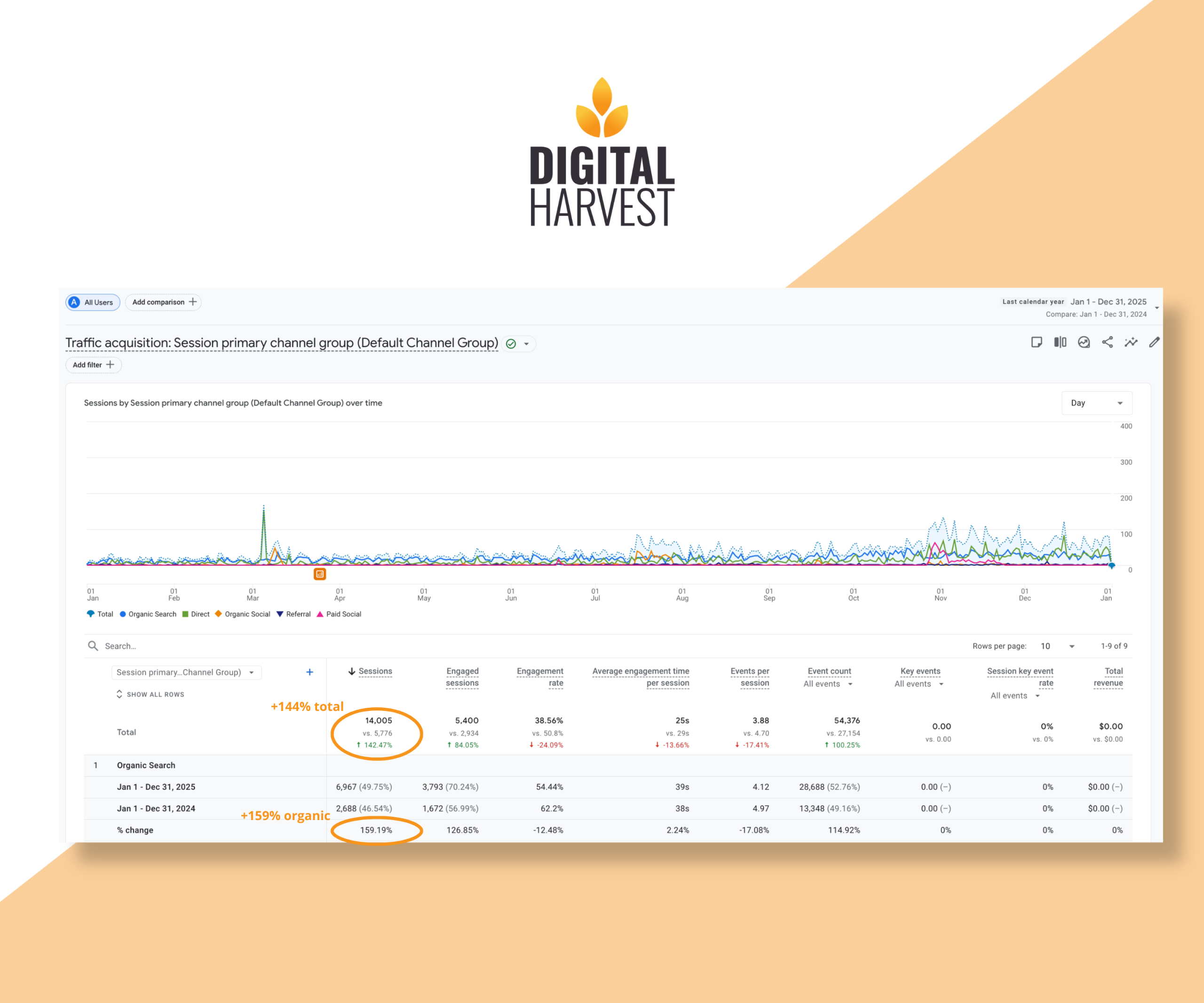
This growth was not evenly distributed throughout the year. The most noticeable gains occurred in the second half, which lines up with a significant increase in publishing activity across both the blog and YouTube.
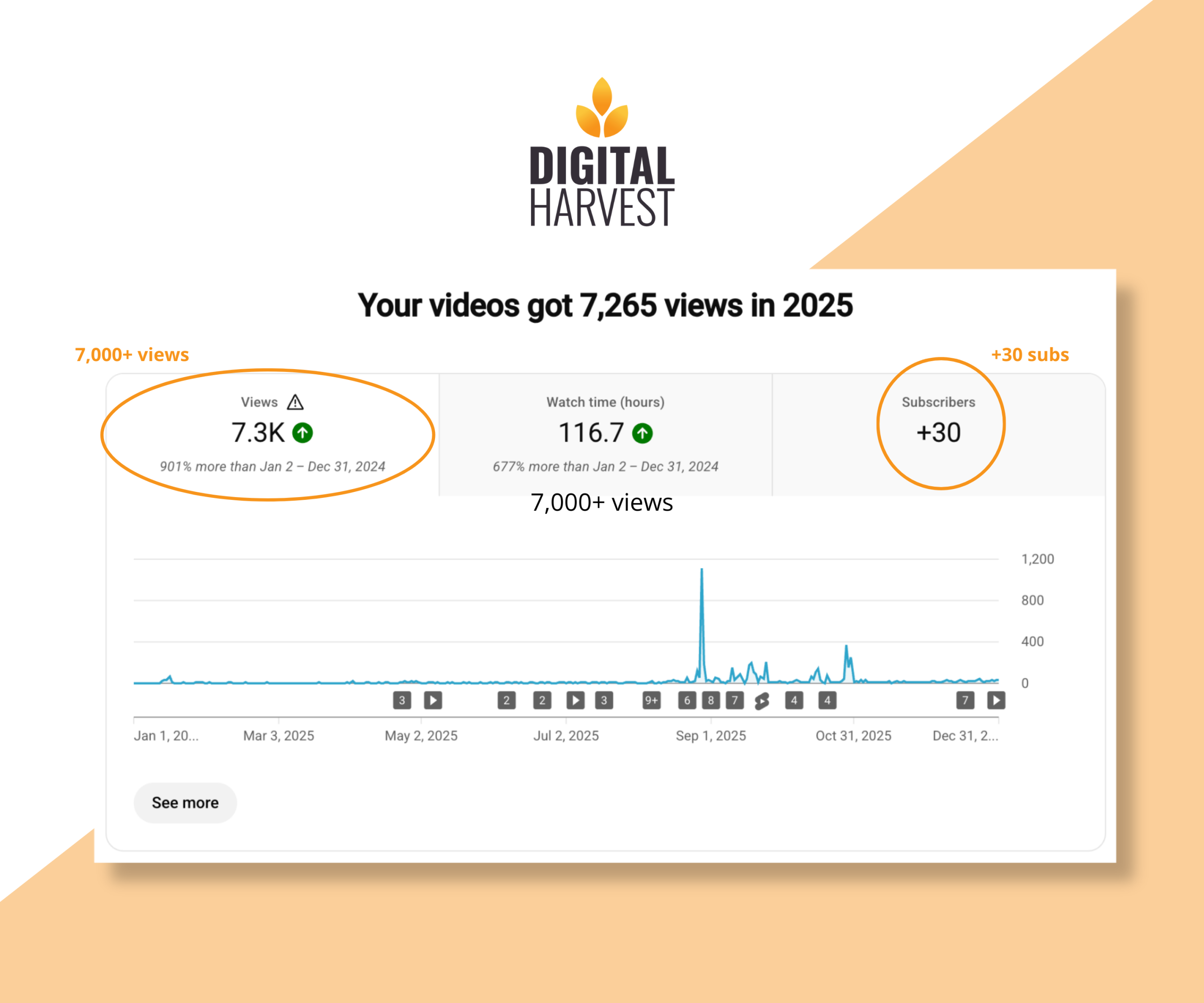
YouTube played an important supporting role. In 2025, Digital Harvest published 64 videos, which generated just over 7,000 views and 30 new subscribers. While the posting schedule was somewhat sporadic, activity clearly ramped up in the latter half of the year and contributed to increased brand visibility and traffic.
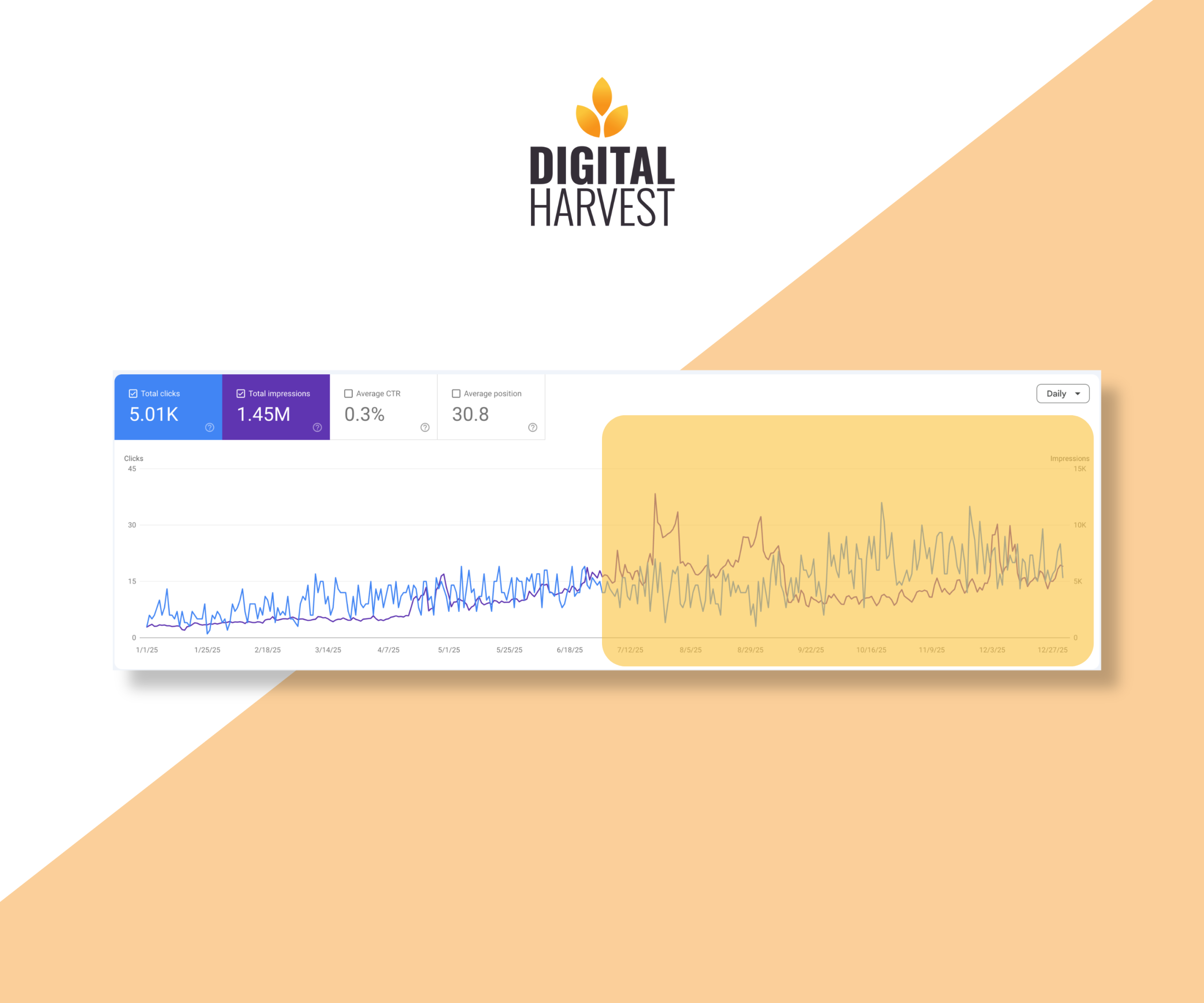
Google Search Console data reinforces the same story. Clicks and impressions trended upward in the second half of the year, showing that the content was earning more visibility across search results over time.
What We Actually Did: More Publishing Volume in 2025 (Blogs and YouTube)
The most obvious change was volume. In 2025, Digital Harvest published more than 200 blog posts. The year before, only six posts went live. On YouTube, the team published 64 videos in 2025 compared to five in 2024.
Publishing at that level created more entry points into search. Each blog post and video was built around relevant keywords, long tail keywords, and a clear content plan designed to attract qualified traffic from organic search. Every new post and video represented another opportunity to capture demand from people actively looking for answers.
That said, volume alone was not the strategy. More than half of the blog content was intentionally experimental. The goal was to test whether AI-assisted content could scale without becoming generic or disposable.
Instead of chasing a small set of high-level keywords, the focus was on creating many focused pieces that addressed specific audiences, situations, or questions. That approach increased relevance and made it easier to earn meaningful search traffic, improve keyword rankings, and support long-term SEO efforts across the site.
This aligns with Google’s own guidance on creating helpful, reliable, people-first content. When you publish at volume, the temptation is to scale page templates and push out the same format repeatedly, but that’s where content quality drops. Our specific SEO strategies worked best when we kept a clear content plan and treated every article like it had to earn its place.
The Strategy That Made AI Content Work: “Generic Topics” Rebuilt Into Niche Frameworks
More than half of the 200 posts we published were experimental in nature. We were looking at generic topics we could scale, then rebuilding them into long tail keywords and niche frameworks that actually match what users search for.
Here’s the exact example we used. If we took a topic like fun things to do in Albuquerque, New Mexico, instead of writing one generic article, we broke it into multiple versions for different audiences and contexts.
We created:
- Fun things to do in Albuquerque for families with toddlers
- Fun things to do in Albuquerque when you’re visiting as a DINK (dual-income, no kids)
- Free weekday things to do in Albuquerque for families with small children
That’s one core topic turned into multiple angles, each designed to fit a specific target audience. The underlying lesson is straightforward. The same base topic can become multiple articles, each with a better chance to match intent, rank, and drive more traffic because it’s not fighting every other generic page.
This is where AI SEO and AI search intersect with practical SEO strategy. AI can help you create content faster, but the win comes from how you structure the information and how tightly it fits the search query.
This approach translates cleanly into service industries. If an HVAC company writes “how to diagnose a broken furnace,” the results will be generic and forgettable. If they write troubleshooting content by system type, brand, or scenario, it becomes harder to copy and more useful, and it often competes better for first page placement.

That’s the reality. If you want your top-ranking pages to stay competitive, you need comprehensive coverage that’s built on specificity, not broad summaries that every marketing team can generate in five minutes.
How to Make AI Content Stand Out in 2026: Specific + Unique + Personal Authority (AI SEO + AI Search)
The reason this matters so much in 2026 is that everyone can create generic articles now. AI agents, AI tools, and even simple automations can produce “good enough” drafts, but good enough does not win in competitive search engines for long.
Differentiation comes from uniqueness, specificity, and authority. If you want AI SEO to work, you need to give AI-generated content something it cannot invent on its own. That’s where we focus on three methods that consistently improve content optimization:
- Insert your own authority and expertise into the page, almost like quoting yourself. This is how you make the content feel personal and grounded in real-life examples.
- Borrow expertise when needed by citing sources. This makes your content harder to replicate and improves quality signals that impact keyword rankings.
- Bring in supporting insights from other YouTube videos or a podcast episode clip when it adds proof or context. This is a simple way to reinforce what’s being said without adding fluff.
This ties directly to how Google evaluates content quality. Google filters out content that adds nothing new. So when people say that Google hates AI content, what they really mean is that Google hates generic content.
AI is a tool. The advantage comes from how intentionally it is used.
The Editorial Process Digital Harvest Used (Humans, AI, and QA)
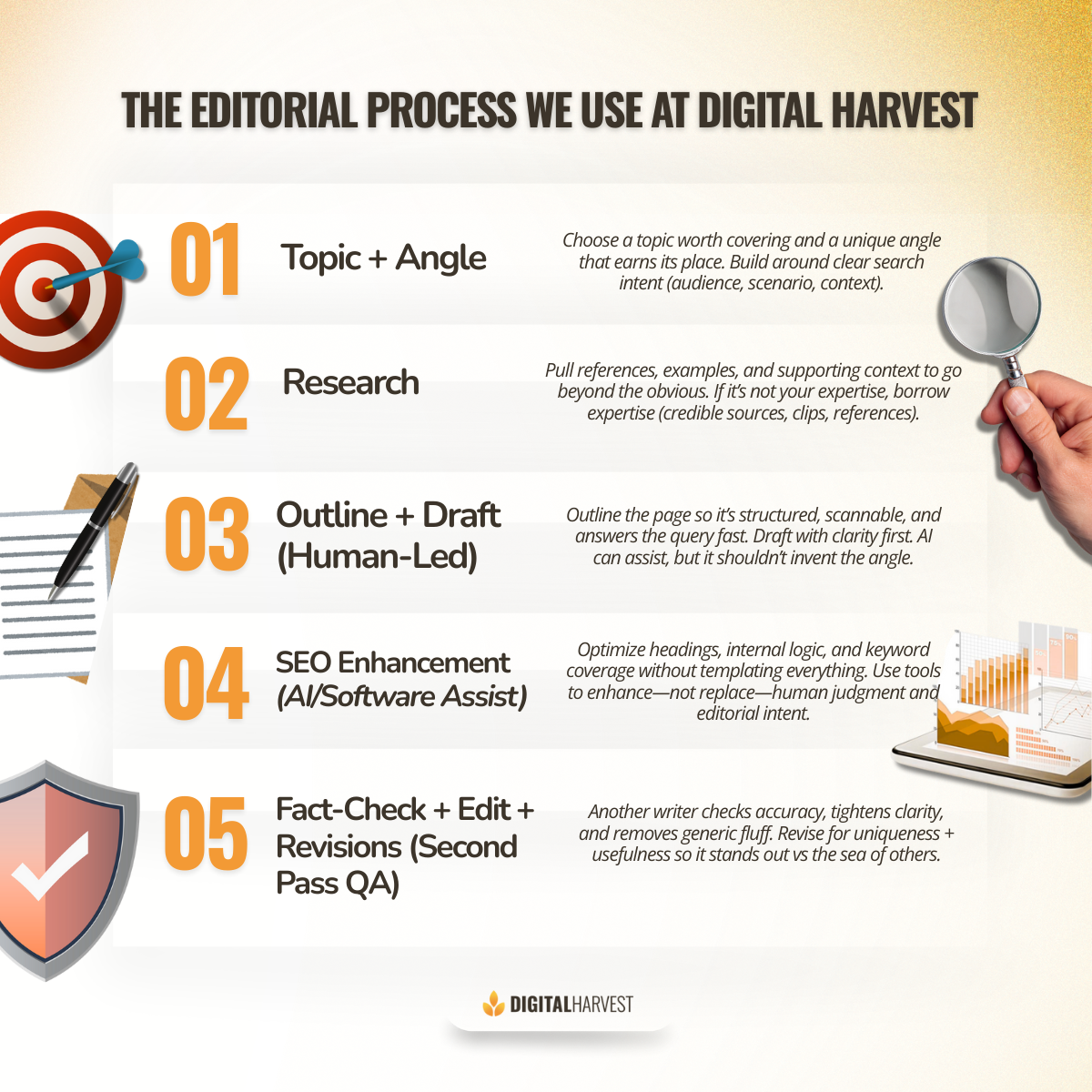
The editorial process was a critical part of making AI-assisted content work for us. It ensured high-quality content, strong content optimization, and structured content that search engines could understand and rank. Digital Harvest relied on two writers with journalism backgrounds to guide production.
Each piece started with topic selection and a clear angle. Writers conducted research, built an outline, and drafted the content. AI and supporting software were used to enhance the copy for SEO, not to replace human judgment.
After the draft was complete, another writer reviewed the piece. Fact-checking, editing, and revisions focused on clarity, accuracy, and uniqueness. This second layer ensured the content stood apart from similar articles already published online.
AI cannot naturally take a different angle unless it is directed to do so. The editorial workflow provided that direction.
What Worked Best and What We’ll Double Down On Next
Not every experiment performed equally. One clear win came from YouTube content around Google Business Profile verification. Four videos in this category took off and drove the majority of converting traffic and leads.
These videos addressed a specific, high-intent problem. That combination of urgency and clarity made them especially effective.
Next year, we’re doubling down on the same principles that got us here. We’re going to keep producing unique, specific content, keep publishing on YouTube, and keep tying that visibility back to the site. We’re also keeping the editorial QA process because that’s what protects content quality at scale.
Final Steps for Applying This to Your Business
- Publish more content, but avoid generic topics.
- Turn one idea into multiple niche-focused pieces.
- Add authority through firsthand experience and cited sources.
- Use a real editorial process with research, outline, writing, SEO enhancement, and fact-checking.
How to Use This AI SEO Approach in 2026
This AI SEO case study comes down to a simple transformation.
- Volume created more opportunities.
- Specificity improved relevance.
- Authority made it harder to copy.
- Editorial QA kept quality high.
That combination supported traffic growth and improved how our pages performed in search results over time, including improved organic clicks and stronger visibility signals.
If you want to talk through how to apply this to your own campaign, you can book a call with me or reach out to the Digital Harvest team.
We’re happy to help you explore how this framework can support your business and drive real growth.
Frequently Asked Questions
Does Google penalize AI content?
Google doesn’t penalize AI content simply because it’s AI. The risk is publishing generic, low-value pages that don’t add anything new for users. If the content is helpful, specific, and unique, it can compete like any other page in Google search.
Can AI-written content rank on Google?
Yes, AI-written content can rank, but the best results come when AI-generated content is shaped by human expertise. The content needs strong relevance, clear structuring of information, and the kind of uniqueness that makes it stand out in search engines.
What makes AI content feel generic and how do you avoid that?
AI content feels generic when it lacks specificity, real-life examples, and clear relevance to the target audience. Avoiding this requires a strong content plan, focused keyword research, and clear direction for AI models. In our AI SEO case, we optimized content by narrowing topics, using long-tail keywords, and adding firsthand experience so the content delivered the most value.
How many blog posts do you need before SEO starts working?
No fixed number of blog posts guarantees results, but consistent content production is critical for SEO efforts. In this case study, publishing more articles created more opportunities for organic search visibility and qualified traffic. As content accumulates, search engines gain more real time data to evaluate relevance, leading to stronger organic performance and traffic growth over time.
Should you start with YouTube or blogging first for SEO?
Both YouTube and blog posts can support AI-driven search results and organic search when aligned with the same SEO strategy. In this AI SEO case study, YouTube videos supported the site by driving qualified traffic, improving lead quality, and reinforcing topical authority.
What matters most is allowing users to find helpful, structured content wherever they search. When video and written pages work together, they strengthen overall site SEO and increase monthly organic visits.
How do I get in touch with Digital Harvest?
We’re always happy to help. If you have questions about AI SEO, content strategy, or whether this approach makes sense for your business, the easiest way to get in touch with Digital Harvest is to call (505) 365-1545.
You can also book a discovery call or send us a message through the contact form. We’ll walk through your situation and help you decide if we’re a good fit before taking the next step.