
When to Use Google Local Service Ads vs. Google PPC Ads for Plumbing and HVAC Businesses
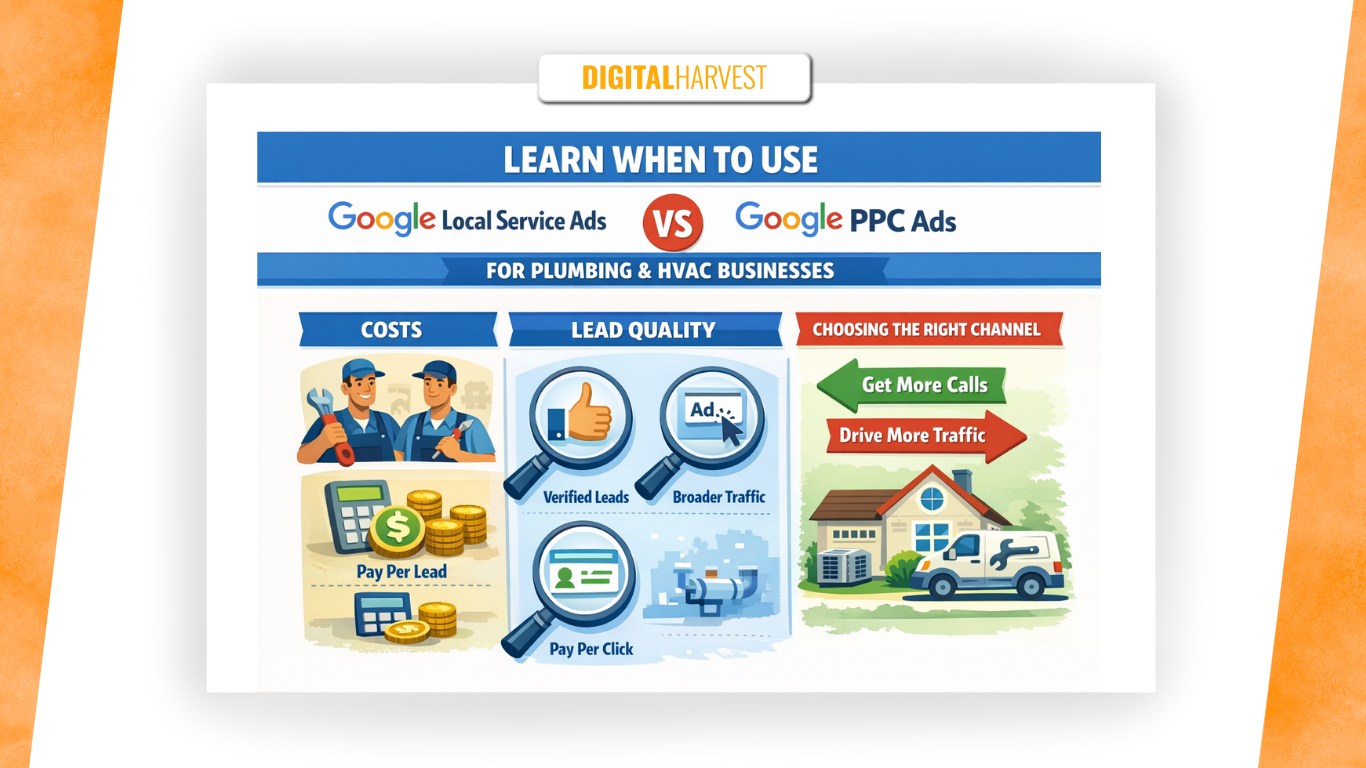
If you own a plumbing or HVAC business, you’ve probably asked yourself how to choose between Google Local Service Ads vs Google PPC. Both are paid ads inside Google search results, and both can generate phone calls and booked jobs. But they are built for different stages of a business and different levels of readiness.
This is where many local service providers get stuck. The advertising strategy depends on budget, infrastructure, and how much control the business can realistically manage. Choosing the wrong marketing channel too early often leads to wasted ad spend and frustration.
This breakdown explains where each ad type appears in search engine results, how the pay structures differ, and how local service businesses should sequence these advertising platforms to maximize ROI as they grow.
Where Google Local Service Ads and Google Ads Show Up
When someone performs Google searches for furnace repair or emergency plumbing, the order of the search results matters.
At the very top of the Google search results, you will usually see Local Service Ads, also called Google Local Service Ads.
These service ads show the business name, reviews, and trust signals like the Google Guaranteed badge or Google Screened status. Prospective customers can call or book directly from the ad. For official setup and eligibility details, see the placement in the Google Local Services Ads Help Center.
These ads are designed for local intent. They connect nearby customers with local businesses in a defined service area. For many service-based businesses, this placement creates instant credibility before a user even visits a website.
Below Local Service Ads, you will typically see Google Ads, also known as PPC ads or pay per click ads. These ads rely on ad copy and send users to landing pages or service pages. Calls are possible, but users click first and then decide. Google outlines how these ads work inside the Google Ads Help Center
Below paid advertising, the page continues with:
- The Maps section, sometimes with an ad
- Organic results and traditional rankings
Local Service Ads were previously called Google Guaranteed, and while the name changed in October 2025, the function and placement stayed largely the same.
The Key Differences Between LSA and Google Ads for Plumbing and HVAC
Although both ad types appear in Google search engine results, they operate very differently as an advertising platform.
Understanding how Local Service Ads differ from Google Ads is also important if you want to accurately grade your LSA leads.
Difference #1: How You Pay (Lead-Based vs Click-Based)
The most important difference is how businesses pay.
With Google Local Service Ads, you only get charged by Google when they send you a good lead.
With Local Service Ads, the model is closer to pay per lead. Google evaluates whether a lead is qualified, and businesses can respond to and dispute leads when needed. This structure is built to prioritize qualified leads and service quality.
This approach works well for local service businesses that depend heavily on phone calls and fast response times.
With Google PPC, the model is pay per click. Businesses pay when users click the ad. There is no guarantee that a click turns into a lead, a customer, or booked jobs. If keywords, targeting, or setup are off, paid advertising spend can increase without results.
Here’s what it really comes down to. Local Service Ads show you your cost per lead more clearly. Google PPC works, but only if you stay on top of your budget.
Difference #2: Cost Predictability vs Cost Flexibility
Local Service Ads tend to be more predictable. Cost per lead usually stays within a defined range throughout the year.
In Albuquerque, for example, Local Service Ads have produced leads as low as $45 during peak seasons and around $65 to $75 during slower periods. This predictability helps local service businesses plan staffing and cash flow.
Google PPC behaves differently. Costs fluctuate based on competition, bidding, and how ads are structured. In some locations, PPC costs more than Local Service Ads. In others, it can outperform when set up correctly.
The nuance is important. PPC ads can reach a broader audience and allow more precise targeting, but only when campaigns are managed properly and budgets are sufficient.
Difference #3: Setup Complexity and What It Takes to Win
Local Service Ads are relatively simple to launch. Businesses must complete Local Services Ads verification, set a budget, and choose specific services they want calls for. Reporting, calls, and leads live inside the platform.
There are limitations. Lead flow can slow down even when budgets are active because Google controls placement signals. Optimization options exist, but they are limited.
Google PPC requires significantly more infrastructure. Successful PPC requires:
- Keyword research and search term management
- Multiple versions of ad copy
- Dedicated landing pages built for conversion
- Call tracking and form tracking to measure real results
Cost per click alone does not indicate success. True performance is measured by cost per lead, phone calls, and booked jobs.
Bonus Tip: The “Right Order” to Run These Channels as You Grow
The biggest takeaway is sequencing.
Local Service Ads work with a Google Business Profile, a website, and a phone number. Reporting is built in, which reduces complexity early on.
For early-stage HVAC contractors and plumbing businesses with limited budgets, this simplicity matters.
As the business grows past $1M in revenue, local SEO and organic results help rank higher and reduce long-term acquisition costs. When budgets grow to roughly $15,000 per month or more, Google PPC becomes viable to add alongside Local Service Ads.
If you need a practical guide for improving organic visibility as your business scales, Google’s SEO Starter Guide explains the core principles.
The long-term goal is running both ad types together. One provides predictability. The other provides control.
Next Steps for Your Plumbing or HVAC Ad Strategy
- For business owners deciding what to do next:
- Start with Local Service Ads for predictable pay per lead results
- Add Google PPC when landing pages, tracking, and budget are in place
Run both channels together as the business scales
This approach gives you clearer visibility into where leads are coming from, how much they cost, and which channel is performing at each stage of growth.
If questions come up along the way, they are always welcome and reviewed closely.
If you want a clear plan tailored to your market, reach out to us at Digital Harvest and fill out the contact form to book a call with us. We’ll help you sort through your options and focus on what actually brings in more HVAC and plumbing customers without wasting ad spend.