
How to Rank Higher on Google Maps for Home Service Businesses (What Matters vs What Doesn’t)
If you run a home service business, one of the biggest questions you probably have is how to rank higher on Google Maps and generate more phone calls from local customers. Ranking on Google is often the difference between steady lead flow and wondering why the phone isn’t ringing.
What surprises many home service providers is that some ranking factors are in your control and truly affect your local visibility, while others either don’t matter much or can’t be influenced at all. Many businesses waste time chasing tactics that don’t move the needle.
In this guide, I’ll break down how Google Maps actually works for home service businesses, why it differs from traditional SEO search results, and the three core ranking factors that determine whether your Google Business Profile appears in local search results.
Key Takeaways
- Google Maps results and “top 10” organic results are different algorithms and don’t always show the same businesses.
- Google Maps rankings boil down to relevance, distance, and prominence.
- Distance (proximity) matters most but is the least controllable.
- Relevance improves when your GBP and website match what people search.
- Prominence is where you can gain the biggest edge: review velocity, responses, directories/citations, and links.
- Focus on what moves these three pillars instead of random “hacks”.
Step Zero: Understand Why Maps Rankings Don’t Match “Top 10” Website Rankings
One of the most important things to understand about ranking on Google Maps is that the algorithm is different from the one used for traditional SEO results.
If you search for something like AC repair, emergency plumber, or HVAC company, you’ll usually see two sets of search results:
- The Map Pack (Google Maps listings with a business profile)
- The traditional SEO results (website rankings)
The businesses ranking in Google Maps are often completely different from the companies ranking organically in traditional SEO listings.
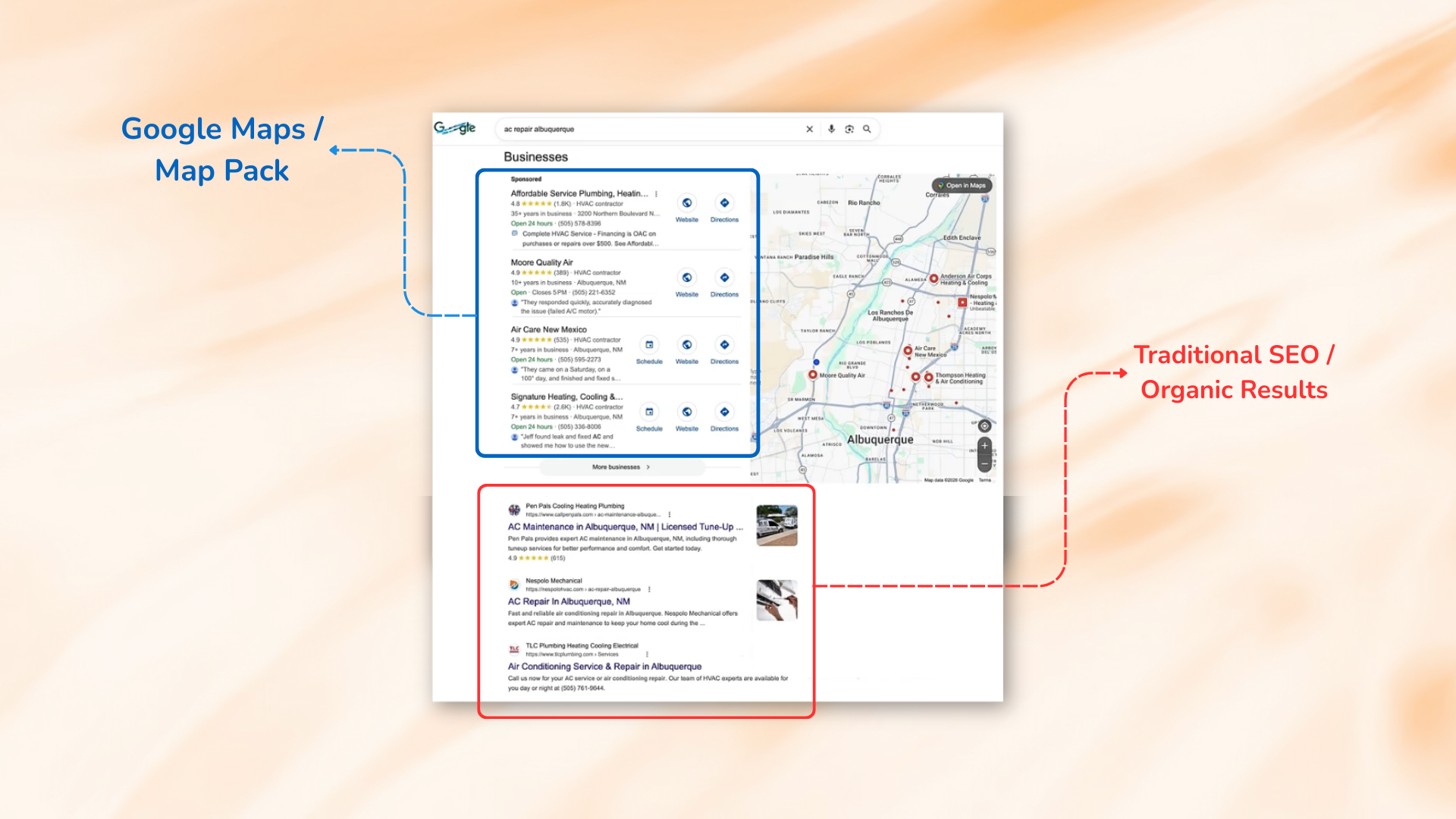
This happens because Google Maps uses a different system to determine which businesses appear in local results. A company with strong service pages and landing pages may rank well organically but still struggle to appear in the Map Pack.
For home service businesses, this difference is huge. Many companies focus heavily on traditional SEO and ignore the signals Google considers when deciding which business listing appears in Google Maps.
If your goal is to generate leads and phone calls from local customers, you need to understand how Google considers relevance, distance, and prominence when ranking businesses in Maps. According to the official Google Business Profile Help, these are the core signals that influence local rankings.
Once you understand these three pillars, the rest of your local SEO strategy becomes much clearer.
The 3 Ranking Factors That Actually Drive Google Maps Visibility
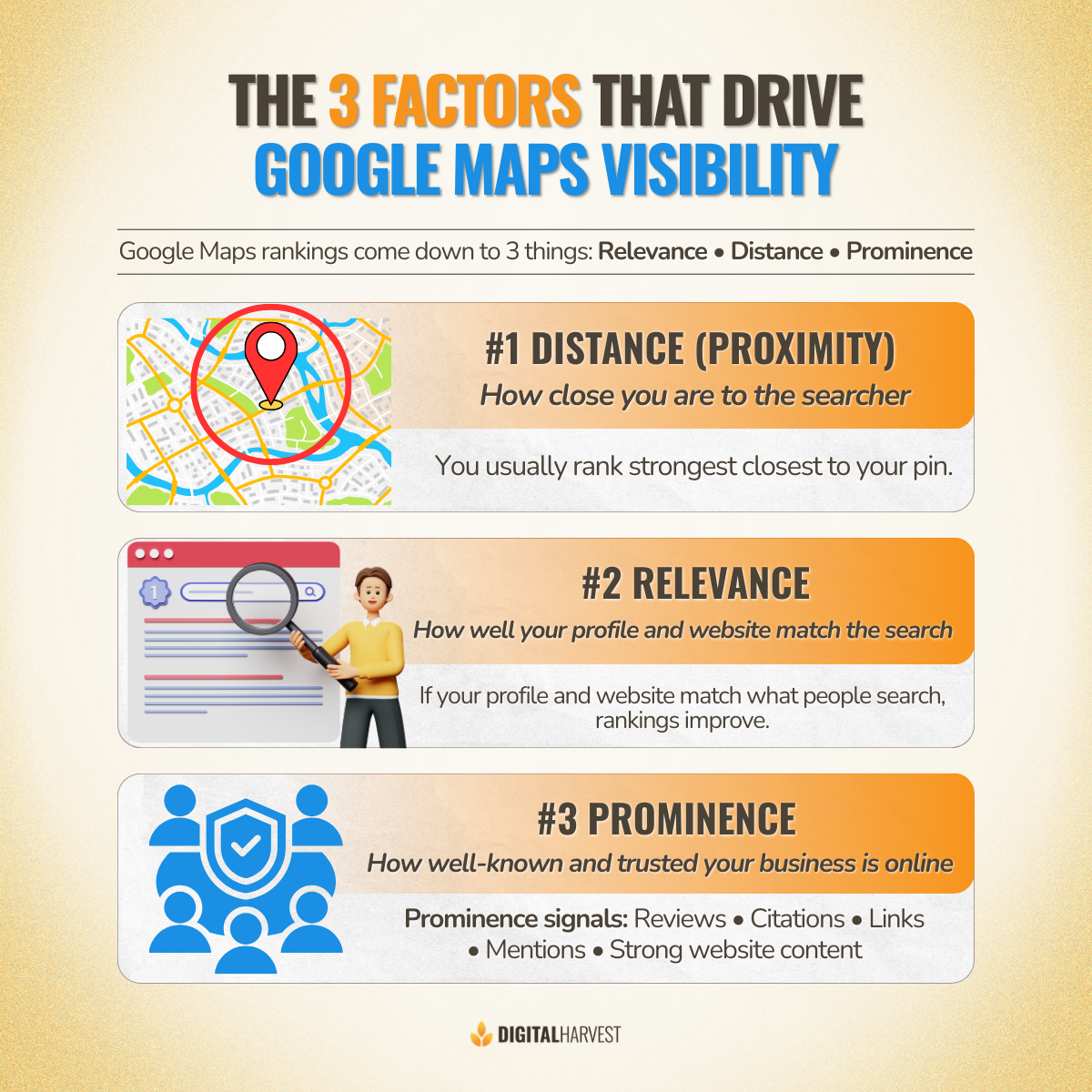
When it comes to ranking higher in Google Maps, everything comes down to three primary factors.
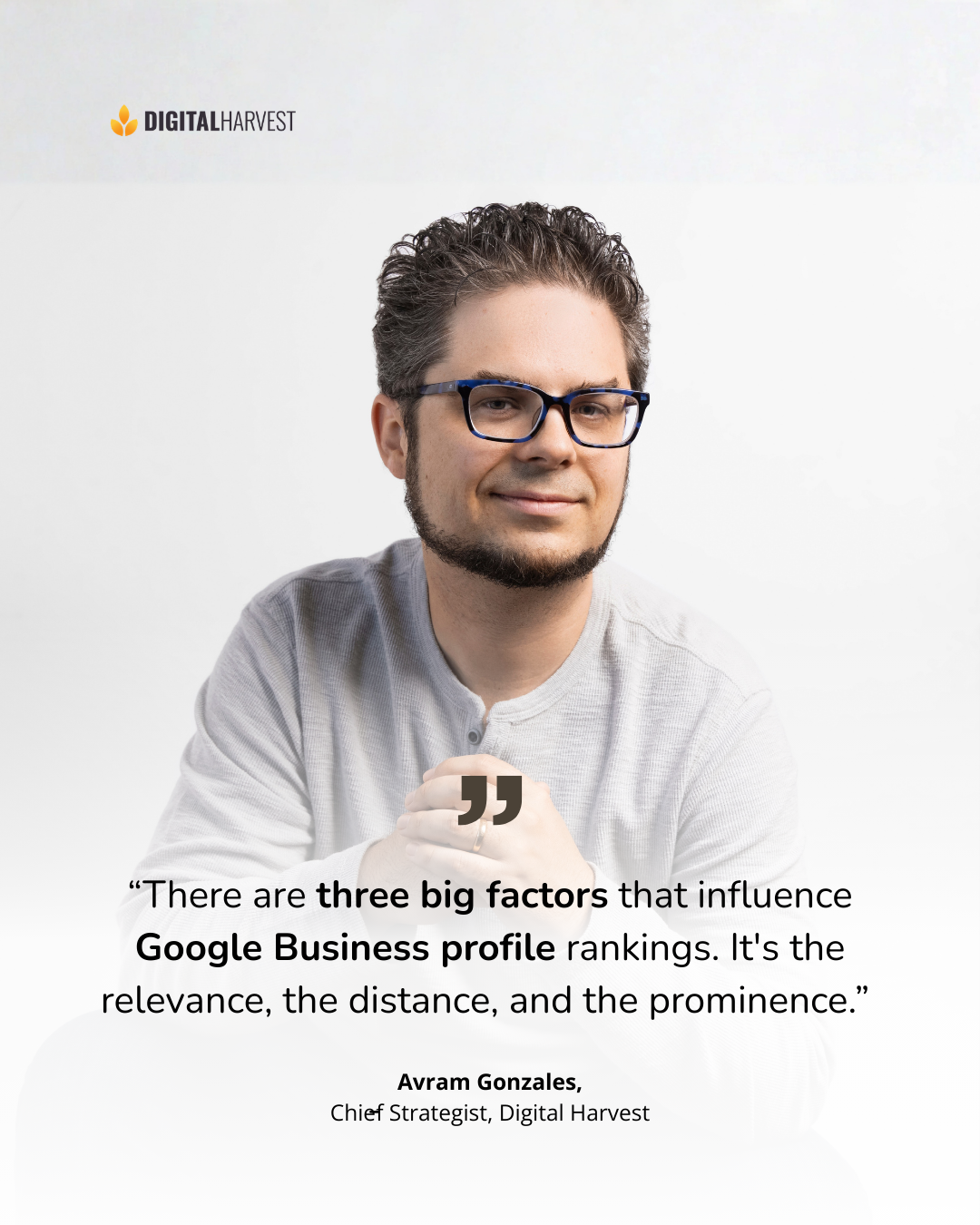
“There are three big factors that influence Google Business profile rankings. It's the relevance, the distance, and the prominence.”
These factors determine how your business profile appears in the Map Pack and local search results.
Here’s how they work:
- Relevance: How well your Google Business Profile and website content match what someone is searching for.
- Distance: How close your physical location is to the person performing the search.
- Prominence: How well-known your business is across the internet through reviews, links, citations, and mentions.
The rest of this guide breaks down each ranking factor in detail so home service providers can understand what actually moves the needle.
Factor #1: Distance (Proximity): What You Can’t Control, and the One Thing You Can
Distance, often called proximity, is one of the most powerful ranking factors in Google Maps.
Google strongly favors businesses that are physically close to the searcher. If someone searches for AC repair near me, Google typically shows businesses that are closest to the person performing the search.
This means even if you’re the best HVAC professionals in your city, you may not appear if the searcher is far from your physical location.
Some aspects of distance are completely outside your control:
- Where the customer is located when they search
- The physical location of your office
- The geographic distribution of your competitors
However, there is one important nuance that many service businesses overlook.
The way your Google business listing is configured can affect your local presence. Businesses that have a visible physical address and physical location tend to have an advantage compared to service area business listings, where the address is hidden.
Google explains how this works in its Service Area Business documentation. A service area business can still rank in Google Maps, but companies with a visible address often have stronger location signals.
Some larger home service businesses even relocate offices strategically to move closer to ideal customers or dense neighborhoods.
Most small businesses don’t need to go that far. Instead, the key takeaway is this:
You’ll typically rank strongest closest to your pin. Your goal is to maximize relevance and prominence so you dominate within your service area.
If you’re setting up a home-based business listing, Digital Harvest has a helpful guide that walks you through how to verify a Google Business Profile at a home address and get your listing set up the right way.
Factor #2: Relevance: Make Your Profile and Website Match What People Search
Relevance measures how well your business profile matches what a potential customer is searching for.
Google looks at both your Google Business Profile and your website content to determine whether your business matches the search intent.
For example, if someone searches for emergency plumbing services, Google tries to determine which businesses offer emergency plumbing services and which ones best match that query.
Relevance depends heavily on the accuracy and completeness of your business information.
One of the simplest ways to improve relevance is to complete every possible section inside your Google Business Profile.
That includes:
- Services offered
- Business hours
- Service area
- Photos
- Business categories
- Business description
- Customer testimonials and reviews
Anything Google allows you to add should be filled out.
Your website content also plays a major role in service relevance. If your Google Business Profile says you offer AC repair, but your website doesn’t clearly mention it on a dedicated page, Google has less evidence that you’re the best match.
A strong website structure for home service providers usually includes:
- Individual service pages for each core service
- Service area pages targeting city names and location-based keywords
- Clear business name, service descriptions, and relevant keywords
These pages help Google understand the services you offer and the areas you serve.
Here’s a simple relevance self-check:
Google Business Profile
- All services clearly listed
- Accurate business hours
- Service area defined
- Photos and business details added
Website
- Dedicated landing pages for services
- Clear service area pages
- Keywords aligned with customer search intent
- Matching information between your website and business profile
If your website and Google Business Profile are aligned, your chances of ranking in local search results increase significantly.
If you want help diagnosing alignment issues, you can request a website and SEO Audit from our team at Digital Harvest to uncover what may be affecting your visibility and identify clear steps to improve your search performance.
Factor #3: Prominence: Where You Can Gain the Biggest Edge
Prominence is the ranking factor where most businesses have the ability to outperform competitors.
Prominence measures how well-known your business is across the internet. Google looks at real-world signals that indicate trust, authority, and visibility.
Prominence signals include:
- Online reviews and positive ratings
- Customer testimonials and social proof
- Local citations and directory listings
- Links from other websites
- Mentions in articles or local media
- Depth of website content
If many businesses are competing in a small town or large city, the companies with stronger prominence signals usually appear higher in Google Maps.
Prominence is where local SEO campaigns often focus the most effort.
Prominence Lever #1: Review Velocity (Not Total Count)
Many small businesses assume that the total number of Google reviews is the primary ranking factor.
In reality, something else matters more.
“The total number of reviews is not a significant ranking factor compared to the review velocity, how many reviews that you are getting over a period of time.”
Review velocity refers to how consistently your business generates new Google reviews.
A business that receives more reviews consistently often outranks competitors with older reviews but little new activity.
This explains why newer home service businesses sometimes appear quickly in local rankings. They often generate reviews faster than established competitors.
For companies like an HVAC company, AC repair provider, or emergency plumber, encouraging satisfied customers to leave reviews creates powerful social proof and helps build sustainable visibility.
More reviews also increase click-through rates because potential customers trust businesses with strong positive ratings.
Prominence Lever #2: Directories/Citations (50–60 Baseline Listings)
Another major prominence factor is local citations.
Citations are listings of your business across directories such as:
- Yellow Pages
- Industry directories
- Local chamber sites
- Service marketplaces
- Business directories
A strong local SEO foundation usually includes 50 to 60 directory listings with consistent business information.
These listings reinforce your local presence and help search engines verify that your business exists and operates in a specific location.
Problems arise when:
- Listings are missing
- Listings contain incorrect information
- Business name, address, or phone number are inconsistent
Consistency across these citations strengthens trust signals and supports higher rankings in local search.
Prominence Lever #3: Links and Being Talked About Online
Another key signal Google looks at is whether other websites link to your business.
Links act as votes of confidence that help Google determine which companies are the best match for a search query.
For example, if a local news site mentions your business, or another website links to your site when referencing your services, Google sees that as evidence your business is recognized.
These links often come from:
- Industry websites
- Local news coverage
- Partner businesses
- Community organizations
Link building is often complex, which is why many businesses hire experts to handle it.
In competitive industries like HVAC, plumbing, or roofing, links often become necessary to maintain higher rankings in Google Maps.
Strong website content also contributes to prominence. Detailed service descriptions, pricing explanations, materials used, and guarantees help Google better understand your business model and build trust signals.
Build Your Google Maps Strategy Around These 3 Pillars
If you want to rank locally and generate leads from Google Maps, the strategy becomes simple once you understand the three pillars.
Google Maps rankings are determined by:
- Distance: how close you are to the searcher
- Relevance: how well your business information matches search intent
- Prominence: how well-known your business is across the web
Distance is powerful but mostly fixed. Relevance improves when your website and Google Business Profile align with the services customers are searching for. Prominence is where businesses gain the biggest advantage through reviews, citations, backlinks, and strong website content.
If you want help diagnosing what’s missing or building a plan to improve your rankings, you can contact our team at Digital Harvest or book a discovery call with me to map out a strategy.
Digital Harvest is a specialized agency focused on Google-focused services and Local SEO for home service businesses across the United States, helping companies generate more high-intent leads and predictable growth through search.
Frequently Asked Questions
What are the main factors that affect Google Maps rankings for local businesses?
Google Maps rankings are primarily influenced by three factors: relevance, distance, and prominence. These signals help Google determine which businesses should appear in local search results and the Map Pack.
How much does proximity affect Google Maps ranking?
Proximity is one of the strongest ranking factors. Businesses closer to the searcher typically appear higher in Google Maps. However, relevance and prominence can still influence rankings within your service area.
Do reviews help you rank higher on Google Maps, or is it just the number of reviews?
Reviews help rankings, but review velocity matters more than the total count. Businesses that consistently generate new Google reviews often see stronger local visibility over time.
What are citations and do they help Google Maps rankings?
Citations are business listings on directories and websites that mention your company name, address, and phone number. Consistent citations strengthen your local presence and support higher rankings.
Does my website affect my Google Business Profile ranking in Google Maps?
Yes. Google evaluates both your Google Business Profile and your website content. Strong service pages, relevant keywords, and accurate business information all help reinforce relevance and improve local rankings.
How do I get in touch with Digital Harvest for help with Google Maps rankings?
You can call Digital Harvest at (505) 365-1545 to speak with a strategist about your situation, or fill out the contact form on the Digital Harvest website to request a discovery call. After reviewing your information, we can help determine what’s holding back your visibility and outline a plan to generate more phone calls and high-intent leads from Google.